

Why Toronto Businesses Are Investing in Custom App Development in 2026
Here is a number that should get your attention: Canadians spend an average of 4.3 hours per day on their smartphones. That is more time on mobile than watching television. For business owners researching application development in Toronto, this single statistic reframes every conversation about how to reach customers, serve clients, and run operations.
Toronto is not just Canada’s largest city. It is the third largest technology hub in North America, trailing only Silicon Valley and New York City. The Greater Toronto Area is home to more than 17,000 technology companies. In 2025, the city attracted over $4.2 billion in tech investment. Neighbourhoods like the MaRS Discovery District, Liberty Village, and the Bay Street corridor are buzzing with innovation.
Against this backdrop, custom application development is no longer a luxury. It is a strategic necessity. Businesses across every sector from Bay Street FinTech firms to King Street retailers to Scarborough healthcare providers are building custom software to automate workflows, delight customers, and outperform competitors who are still relying on generic off-the-shelf tools.
Canada’s app market generated $3.1 billion in revenue in 2025, and the growth trajectory shows no signs of slowing. With 88% smartphone penetration across Canada, there has never been a better or more urgent time to invest in a custom application.
This guide is built for Toronto business owners, founders, and enterprise decision-makers who are ready to understand what app development actually involves, what it costs, and how to choose the right partner. Chameleon Ideas Inc. has compiled this resource to cut through the jargon, present the facts, and help you make a confident, informed decision.
Let’s build something great.
What Is Application Development? A Clear Definition for Toronto Business Owners
Application development is the end-to-end process of planning, designing, building, testing, and deploying software programs called applications or apps that enable users or organisations to perform specific tasks on digital devices including smartphones, tablets, computers, and web browsers.
The word “development” is key. It implies a structured, deliberate process not a one-time event. A quality application evolves through research, iteration, testing, and continuous improvement. Understanding this distinction helps business owners set realistic expectations and avoid the most common pitfalls.
When Toronto companies invest in application development in Toronto, they are not buying a product off a shelf. They are commissioning bespoke software engineered to their exact workflows, their brand identity, and their users’ specific needs.
Distinguishing Between Mobile, Web, and Enterprise Apps
The term “app” covers a broad spectrum. For clarity, here are the three most common categories Toronto businesses encounter:
- Mobile Apps: Downloaded from the Apple App Store or Google Play. They live on your phone and can access native device features: camera, GPS, push notifications, biometrics. Examples: food delivery apps, loyalty programmes, booking tools.
- Web Apps: Accessed through a browser with no download required. They are dynamic, personalised, and interactive far beyond what a static website can offer. Examples: client portals, SaaS platforms, e-commerce systems.
- Enterprise Apps: Large-scale platforms managing complex internal operations across multiple teams, departments, or locations. Examples: ERP systems, HR platforms, custom inventory management, logistics dashboards.
The right category depends on your audience, your goals, and your budget. A great development partner like Chameleon Ideas Inc. will guide that decision before a single line of code is written.
The Essential Roles: Front-End, Back-End, and Full-Stack
Every app has two distinct layers. The front-end is everything the user sees and interacts with buttons, screens, navigation, colour schemes. The back-end is the engine underneath servers, databases, authentication, business logic, and APIs. A full-stack developer works across both layers.
Role | What They Build | Common Technologies |
Front-End Developer | UI, screens, user experience | React, Vue, Swift, Kotlin |
Back-End Developer | Servers, databases, APIs, security | Node.js, Python, Go, SQL |
Full-Stack Developer | Both layers end-to-end | Combination of all above |
For most Toronto SMBs, a full-stack team or a small specialist team managed by an agency delivers the best value. Agencies like Chameleon Ideas Inc. bring the entire skill set under one roof, saving you the headache of hiring and managing individual contractors.
Why a “Product Mindset” Beats a “Coding Mindset”
Many business owners assume app development is primarily a coding exercise. It is not. The most successful apps are built by teams that think like product managers first and programmers second.
A product mindset asks: Who is this user? What problem are we truly solving? How will we measure success? What does version two look like? These questions shape every design and development decision.
A coding mindset, by contrast, focuses purely on technical execution often resulting in a technically functional but commercially ineffective product. Chameleon Ideas Inc. embeds product strategy into every engagement from day one. We do not just build what you ask for, we help you figure out what to build.
The Toronto Tech Ecosystem: Why Local Application Development in Toronto Demands Local Expertise
Toronto’s tech ecosystem is world-class and genuinely unique. Its combination of elite academic institutions, progressive regulation, and an extraordinarily diverse talent pool creates conditions that benefit any business investing in software development locally.
Understanding the local landscape helps you ask smarter questions when evaluating app development companies in Toronto. A partner who lives and works within this ecosystem will build better software for it.
Leveraging the Talent from U of T, TMU, and OCAD
Toronto produces some of the strongest technology and design talent in North America. Three institutions stand out:
- University of Toronto (U of T): Consistently ranked among the world’s top engineering and computer science schools. Home to the Vector Institute for Artificial Intelligence Canada’s leading AI research centre. U of T graduates shape the technical backbone of Toronto’s development community.
- Toronto Metropolitan University (TMU): Formerly Ryerson, TMU’s engineering and business programmes produce career-ready developers with strong practical skills and an entrepreneurial orientation. The DMZ startup incubator on campus has launched hundreds of tech companies.
- OCAD University: Canada’s largest and most comprehensive art and design university. OCAD’s graduates bring the visual design excellence and user experience thinking that separates great apps from forgettable ones.
When you hire a Toronto-based agency, you are drawing on this talent ecosystem. Chameleon Ideas Inc. recruits from and collaborates within this community ensuring our clients benefit from the sharpest minds the city produces.
Navigating Ontario’s Regulatory Landscape (PIPEDA & PHIPA)
Canada’s privacy regulations are among the most rigorous in the world and for good reason. Any app that collects, stores, or processes personal data must comply with federal and provincial law. Failure to do so carries serious legal and reputational consequences.
- PIPEDA (Personal Information Protection and Electronic Documents Act): Canada’s federal private-sector privacy law. It governs how businesses collect, use, and disclose personal information in the course of commercial activity. All apps serving Canadian users must comply.
- PHIPA (Personal Health Information Protection Act): Ontario’s health privacy law. If your app handles any patient or health-related data booking systems, telehealth platforms, clinic portals, wellness trackers PHIPA compliance is non-negotiable.
An offshore development team may have no awareness of these legal requirements. A Toronto-based agency operates within this regulatory environment daily. At Chameleon Ideas Inc., compliance is built into our architecture from the discovery phase not retrofitted after launch.
The Advantage of Same-Timezone Collaboration on King Street
This point is more important than most clients realise. App development is a collaborative, iterative process. It requires fast feedback loops, real-time problem-solving, and the ability to react quickly to changing requirements.
When your development team is 10 to 12 time zones away, a single question can take 24 hours to resolve. Multiply that across a six-month project and you understand why so many offshore engagements run over budget and past deadline.
Working with a team based on King Street West or in Liberty Village means morning standups that work for everyone, same-day feedback on design reviews, and the option to sit down together over coffee when a strategic decision needs to be made. That proximity is a genuine competitive advantage and one that Chameleon Ideas Inc. delivers every day.
Types of Applications Built for Toronto Businesses
Not every business needs the same type of application. The right choice depends on your target users, the functionality required, your timeline, and your budget. Here is a practical breakdown of the application types most commonly built for Toronto businesses in 2026.
Native vs. Cross-Platform: Choosing the Right Performance Tier
Native apps are built specifically for one operating system iOS or Android using Apple’s Swift/Objective-C or Google’s Kotlin/Java. They deliver the highest performance, best access to device hardware, and the most polished user experience. They are, however, more expensive to build if you need both platforms, since you are essentially building two separate apps.
Cross-platform frameworks like React Native and Flutter allow developers to write one codebase that runs on both iOS and Android. The performance gap between native and cross-platform has narrowed dramatically in 2026. For most Toronto SMBs, cross-platform is the pragmatic choice offering 80–90% of the native experience at significantly lower cost.
Choose native when: your app is highly graphics-intensive, uses advanced device hardware, or demands the absolute highest performance.
Choose cross-platform when: you need to reach both iOS and Android users efficiently and cost-effectively.
The Rise of AI-Powered and IoT-Connected Applications
Artificial intelligence is no longer a feature reserved for tech giants. In 2026, AI capabilities are being embedded into applications built for Toronto’s mid-market businesses and the results are transformative.
- AI-powered recommendation engines: Personalising product suggestions, content feeds, and service offerings for individual users.
- Natural language interfaces: Allowing users to interact with your app through conversational inputs chatbots, voice commands, smart search.
- Predictive analytics dashboards: Turning your app’s data into actionable business intelligence, forecasting demand, and flagging anomalies.
- IoT-connected applications: Linking physical devices, smart sensors, wearables, industrial equipment to cloud-based platforms for real-time monitoring and control. Increasingly relevant for Toronto’s manufacturing, healthcare, and property management sectors.
Chameleon Ideas Inc. builds AI-readiness into every application architecture, ensuring your investment grows in value as intelligent capabilities evolve.
Progressive Web Apps (PWAs): The Frictionless Alternative
A Progressive Web App is a website built with modern web technologies that behaves like a native mobile app. Users access it through a browser no App Store download required but they can save it to their home screen, receive push notifications, and use it offline.
PWAs offer a compelling value proposition for Toronto businesses: faster to build than native apps, more cost-effective to maintain, and universally accessible across all devices and operating systems.
Best suited for: Businesses that want a mobile-first experience without the friction of app store submission. Excellent for content platforms, service marketplaces, loyalty programmes, and internal tools where the user base is known and controlled.
The App Development Process: From Idea to App Store: Step by Step
One of the most common mistakes Toronto businesses make is treating app development as a single event a moment when a finished product appears. In reality, it is a carefully structured journey. Understanding each phase helps you contribute more effectively and avoid costly surprises.
Phase 1 : Discovery & Strategy: Mapping the Toronto User Journey
Discovery is the most important phase of any app development project — and the one most frequently rushed. A thorough discovery process is what separates apps that succeed commercially from apps that launch and stagnate.
During discovery, your development partner should:
- Define the core problem the app will solve for your business and your users.
- Conduct user research to understand the behaviours, expectations, and frustrations of your target audience.
- Map the full user journey every touchpoint from first interaction to desired outcome.
- Audit competitors and identify differentiation opportunities.
- Define success metrics: what does a successful app look like in 90 days? In one year?
- Produce a detailed scope document, feature prioritisation framework, and technical architecture plan.
At Chameleon Ideas Inc., our discovery engagements typically run two to four weeks and include workshops with your leadership team, user interviews where appropriate, and a comprehensive strategic brief that guides every subsequent decision.
Phase 2 : Product Strategy & Roadmap: Defining Your MVP
Once discovery is complete, the next step is translating your research into a product strategy. This is where the concept of the MVP Minimum Viable Product becomes essential.
An MVP is not a cheap, incomplete version of your product. It is the leanest possible version that still delivers genuine value to your target user and allows you to validate your core assumptions in the real market. The goal is to learn as much as possible, as quickly as possible, with as little investment as possible.
Feature prioritisation follows the MoSCoW method:
- Must Have: Core features without which the app cannot function.
- Should Have: Important features that add significant value but are not launch-critical.
- Could Have: Nice-to-have enhancements for future versions.
- Won’t Have (this time): Features explicitly deferred to a later release.
Deliverables from this phase include a Product Requirements Document (PRD), a prioritised feature list, and an initial product roadmap guiding the evolution from version one to version two and beyond.
Phase 3 : UX/UI Design: From Wireframes to Working Prototype
Design begins long before anyone opens a visual design tool. It begins with wireframes low-fidelity, black-and-white sketches of every screen in your application. Think of wireframes as the architectural blueprints of your app: they define the structure, layout, and flow of the user experience without the distraction of colour, typography, or imagery.
Once wireframes are validated, the design team moves into high-fidelity visual design adding colour, typography, imagery, and brand identity to bring the app to life. These mockups are then assembled into an interactive prototype, a clickable simulation of the app that can be tested with real users before development begins.
Good design in 2026 also means accessible design. Your team should be building to WCAG accessibility guidelines, ensuring your app is usable by people with a range of visual, motor, and cognitive differences.
Deliverables include wireframes, high-fidelity mockups, an interactive prototype, and a complete design system.
Timeline: 3–5 weeks.
Phase 4 : Technical Architecture: Choosing the Right Tech Stack
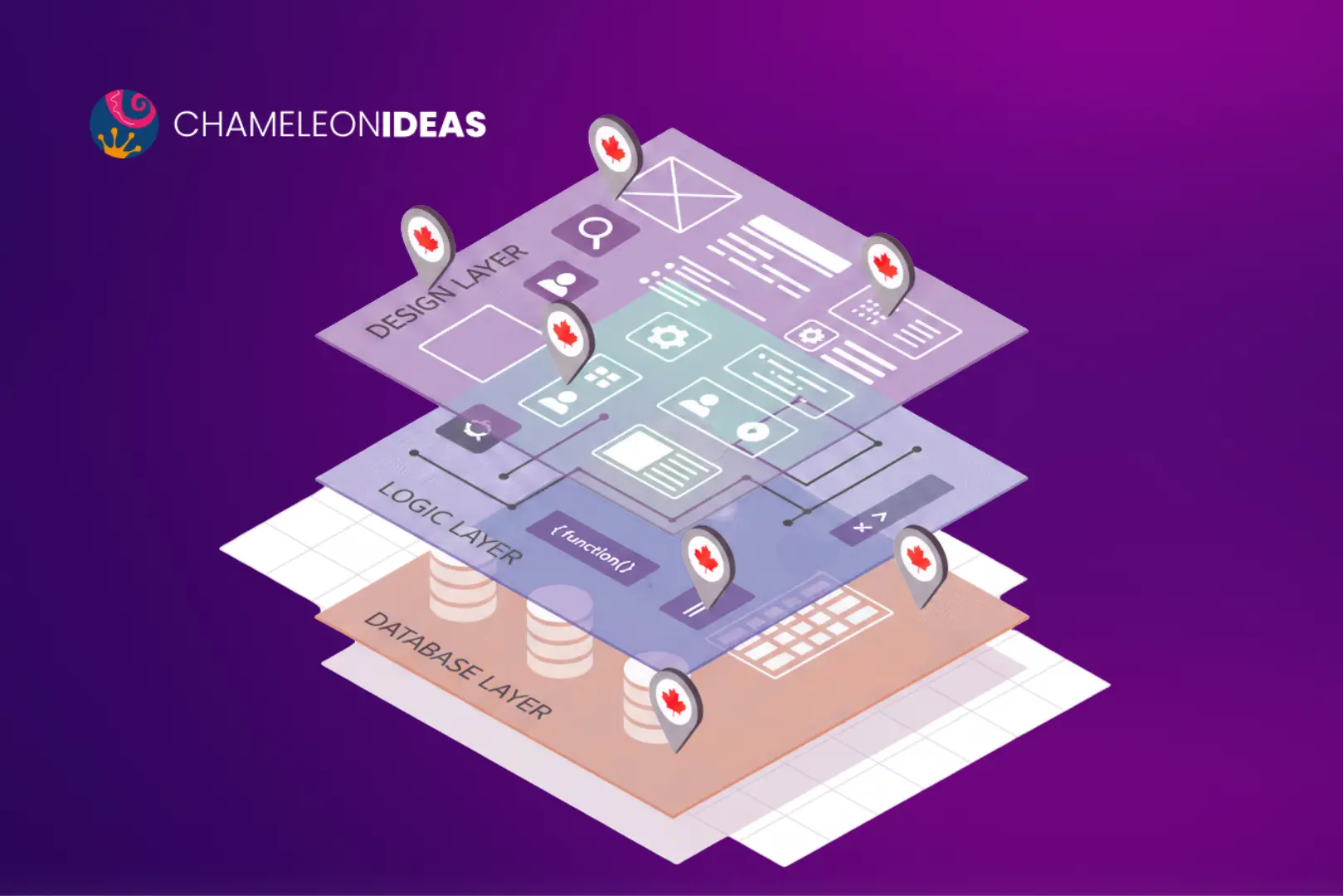
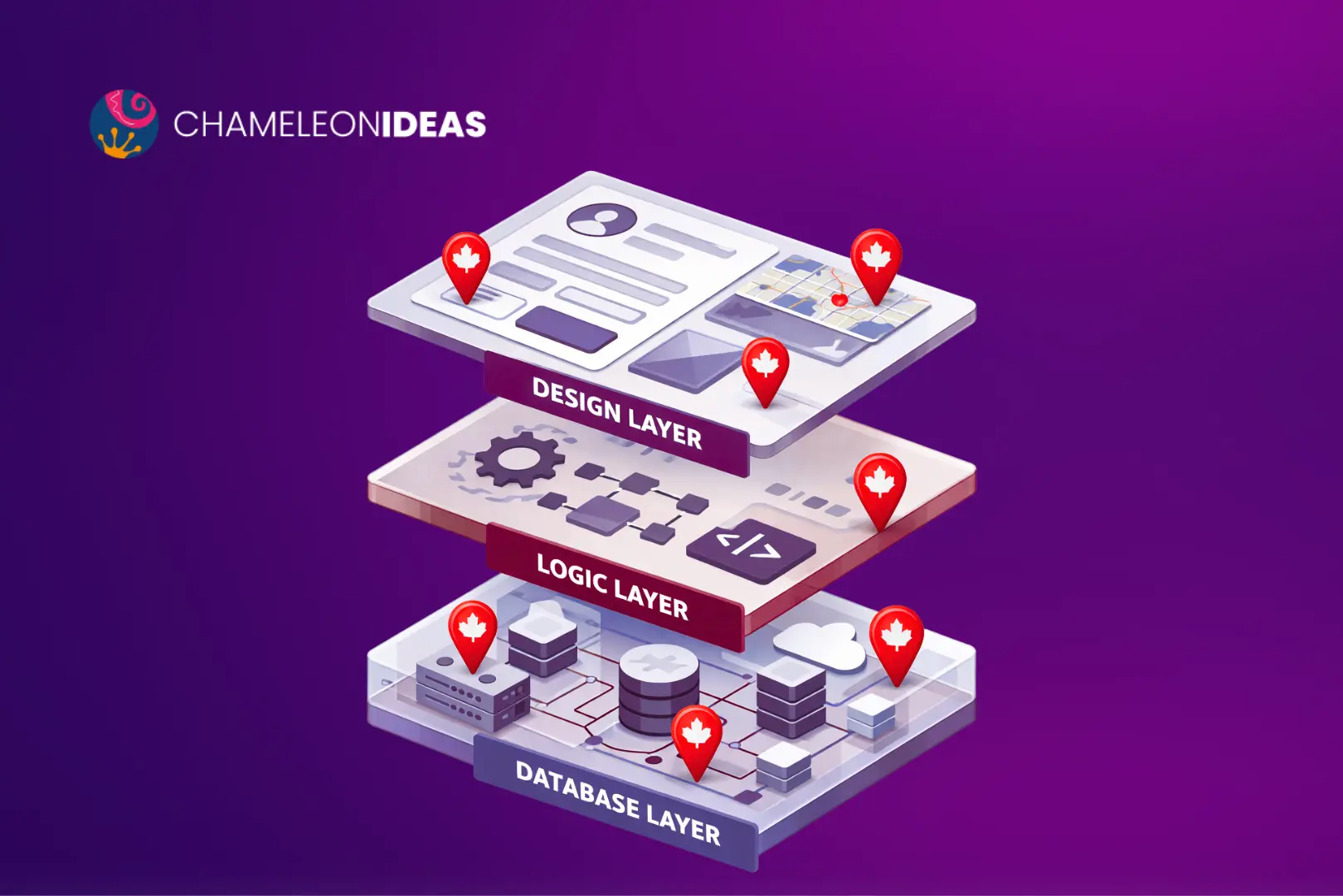
Technical architecture is where your development team defines the engineering blueprint of your application. Your tech stack has three core layers:
- Frontend: The user-facing layer. Common choices include React Native and Flutter for cross-platform, or Swift/Kotlin for native iOS/Android. For web applications, React and Vue.js are widely used.
- Backend: The server-side logic, APIs, and business rules. Popular choices in Toronto’s development community include Node.js, Python, and Go.
- Database: SQL databases (PostgreSQL, MySQL) for structured, relational data; NoSQL (MongoDB) for flexible, document-based models.
For Canadian businesses, data residency is a critical consideration. PIPEDA and PHIPA requirements may mandate that personal or health data be stored within Canadian borders. AWS and Azure both operate Canadian data centres and configuring your infrastructure for Canadian residency is something any reputable Toronto development agency should handle as standard practice.
Timeline: 1–2 weeks.
Phase 5 : Agile Development Sprints: Building in Two-Week Cycles
This is where the actual building happens. In virtually every professional development shop in Toronto, this work runs on Agile methodology short, focused cycles called sprints, typically two weeks each. At the end of every sprint, completed features are demonstrated to you in a sprint review.
Inside each sprint, the team operates through structured ceremonies:
- Daily standup (15 minutes): What was completed yesterday, what is being worked on today, and any blockers.
- Code reviews: All code is reviewed by a second developer before merging catching bugs and enforcing standards.
- Sprint review: A live demonstration of completed features at the end of every two-week cycle.
- Retrospective: The team reflects on what went well, what did not, and how to improve.
You are not waiting six months to see what you paid for. You are reviewing real, working software every two weeks.
Timeline: 3–6 months for a typical MVP.
Phase 6 : Quality Assurance & Testing: Finding Bugs Before Your Users Do
Quality assurance is not a phase that happens at the end of development. In a well-run Agile process, testing happens continuously throughout every sprint.
- Unit testing: Individual components or functions tested in isolation to verify they work as intended.
- Integration testing: Verifying that different modules, services, and third-party integrations function correctly as a connected system.
- User Acceptance Testing (UAT): You or a defined group of real users use the application in a controlled environment to verify it meets your requirements. UAT sign-off is the formal gate to submission and launch.
Deliverables include a comprehensive test plan, documented test cases, bug reports, and resolution logs.
Timeline: 2–4 weeks, with testing ongoing throughout development.
Phase 7 : App Store Submission: Getting Your App Live
Getting your app onto the Apple App Store or Google Play Store is more involved than most first-time clients expect.
Preparation for submission includes:
- App store screenshots showcasing key features across multiple device sizes.
- App description and metadata written with App Store Optimisation (ASO) in mind.
- Privacy policy documentation hosted at a publicly accessible URL.
- Age rating declaration based on the app’s content.
- Full compliance review against platform-specific guidelines.
Apple App Store review typically takes one to three business days. Common rejection reasons include crashes, missing privacy documentation, and in-app purchase implementation issues.
Google Play Store approval is generally faster often within a few hours to two business days though Google conducts ongoing monitoring of published apps post-launch.
Chameleon Ideas Inc. manages the full submission process and maintains a comprehensive submission checklist to minimise rejection risk.
Timeline: 1–2 weeks.
Phase 8 : Launch & Go-To-Market: Reaching Your Toronto Audience
A soft launch releasing to a limited audience before full rollout is one of the smartest strategies available to Toronto business owners. It catches bugs that slipped through QA, generates early reviews that boost App Store credibility, and gives your team time to refine messaging before scale.
Your go-to-market strategy for Toronto should include:
- Organic social media on platforms where your target audience is active.
- Content marketing blogs, guides, and videos driving SEO traffic.
- Email marketing to your existing contact list and waitlist.
- PR and media outreach to Toronto tech publications and local business media.
- Paid digital advertising on Google, Meta, or LinkedIn depending on your audience.
- Community and partnership channels Toronto’s business community is tightly networked, and word of mouth travels fast.
Launch day requires coordinated activity across marketing, PR, customer support, and technical monitoring simultaneously.
Timeline: 1–2 weeks for soft launch.
Phase 9 : Post-Launch Iteration: Learning, Improving, and Growing
Launch day is not the finish line. It is the starting gun for the most important phase of all: learning from real users and continuously improving your product.
From day one post-launch, your analytics should be tracking:
- Daily Active Users (DAU) and Monthly Active Users (MAU)
- Retention rate: what percentage of users return after day 1, day 7, and day 30?
- Churn rate: how many users are stopping use of the app, and when?
- Session length and depth: how deeply are users engaging with features?
- Conversion rate for commercial apps, what percentage completes the key action?
Gather qualitative feedback through App Store reviews, in-app feedback prompts, user surveys, and direct user interviews. After four to six weeks of post-launch data, you will have the foundation to make evidence-based decisions about version two.
Timeline: Ongoing.
App Development Technologies Used in Toronto The 2026 Tech Stack Guide
The technologies your app is built with matter a great deal. The wrong tech stack can limit your app’s scalability, make future enhancements expensive, and create security vulnerabilities. Here is what Toronto’s leading development teams are using in 2026.
Modern Front-End Frameworks: React Native and Flutter
- React Native (Meta): The most widely adopted cross-platform framework globally. Built on JavaScript, the world’s most popular programming language React Native offers a massive talent pool, extensive libraries, and proven scalability. Ideal for apps requiring complex UI, social features, and rapid iteration.
- Flutter (Google): A newer framework using Dart that compiles directly to native code, delivering exceptional performance and pixel-perfect UI consistency across iOS and Android. Growing rapidly in Toronto’s development community due to its speed and visual fidelity.
- Swift (iOS) / Kotlin (Android): For truly native applications where maximum performance and device integration are required. More expensive but delivers the highest-quality user experience on each platform.
Robust Back-End Solutions: Node.js, Python, and Go
- Node.js: A JavaScript-based runtime that excels at handling high volumes of simultaneous connections. Ideal for real-time applications chat systems, live dashboards, collaborative tools. Chameleon’s most frequently deployed back-end technology.
- Python: The leading language for AI, machine learning, and data science integrations. If your app will incorporate intelligent features, recommendation engines, predictive models, and natural language processing Python is the natural choice for back-end infrastructure.
- Go (Golang): Google’s compiled language, prized for speed, efficiency, and reliability at scale. Increasingly chosen by Toronto’s FinTech and enterprise clients where performance under heavy load is non-negotiable.
- PostgreSQL / MongoDB: The most commonly used databases in Toronto’s app development ecosystem. PostgreSQL for structured, relational data; MongoDB for flexible, document-based data models.
Cloud Infrastructure: AWS, Azure, and Google Cloud in Canada
Every modern application runs on cloud infrastructure. Choosing the right cloud provider and configuring it correctly for Canadian data residency requirements is a critical architectural decision.
- Amazon Web Services (AWS): The global leader. AWS’s Canadian regions (Montréal and Toronto) allow businesses to store data within Canada’s borders satisfying PIPEDA and PHIPA requirements. Most widely used by Chameleon’s clients.
- Microsoft Azure: Strong choice for businesses already in the Microsoft ecosystem. Azure’s Canadian Central region (Toronto) provides compliant, high-availability infrastructure with deep integration for enterprise tools like Office 365 and Active Directory.
- Google Cloud Platform (GCP): Preferred for AI-heavy applications given Google’s unmatched machine learning infrastructure. GCP’s Montréal region supports Canadian data residency.
Data residency matters in Canada. Ensuring your user data is stored and processed within Canadian borders is both a legal requirement and a trust signal for your users. Any reputable Toronto app developer should configure this by default.
How Much Does App Development Cost in Toronto? (2026 Pricing Guide)
Cost is the question every Toronto business owner eventually asks. The honest answer: it depends significantly on scope, complexity, and the quality of the partner you choose. What follows is the most transparent pricing guide available for the Toronto market in 2026.
MVP / Starter | Standard | Enterprise | |
Typical Budget | $25K – $75K CAD | $75K – $175K CAD | $175K – $500K+ CAD |
Timeline | 8 – 16 weeks | 4 – 7 months | 7 – 18 months |
Team Size | 2 – 3 people | 4 – 6 people | 8 – 15+ people |
Platforms | 1 platform (iOS or Web) | iOS + Android + Web | All platforms + integrations |
Core Features | 3 – 5 essential features | 8 – 15 features | 15+ features, custom integrations |
Third-Party Integrations | Basic (payments, auth) | Moderate (CRM, ERP, APIs) | Deep (legacy systems, custom APIs) |
AI / ML Features | None | Basic integrations | Custom models + training |
Annual Maintenance | ~$5K – $15K CAD | ~$15K – $35K CAD | ~$35K – $100K+ CAD |
Best For | Startups validating an idea | Growing SMBs scaling operations | Enterprises transforming digitally |
Factors That Drive App Development Costs in the GTA
Understanding what moves the price needle helps you scope your project intelligently and avoid paying for features you do not need yet.
- Number of platforms: Building for iOS and Android simultaneously roughly doubles development time compared to a single platform.
- Third-party integrations: Connecting to payment gateways (Stripe, Square), CRMs (Salesforce, HubSpot), ERP systems, or government APIs adds significant complexity and cost.
- Custom UI/UX design: Bespoke animations, complex navigation patterns, and pixel-perfect interfaces require more design and front-end development hours.
- Security and compliance requirements: PIPEDA and PHIPA compliance, end-to-end encryption, two-factor authentication, and audit logging add necessary but billable complexity.
- AI and machine learning features: Custom model development, training pipelines, and intelligent data processing add significant engineering hours.
Hidden Costs: Maintenance, Updates, and Server Fees
The invoice you receive at launch is not the end of your investment. Sustainable apps require ongoing resources and budgeting for these upfront is a sign of a mature partnership.
- Annual maintenance: Plan for 15–25% of your initial development cost per year, covering OS updates, security patches, dependency upgrades, and bug fixes.
- Cloud infrastructure: AWS, Azure, or GCP charges scale with your usage. A new app might cost $100 to $500 per month; a high-traffic platform could run $2,000 to $10,000+ per month.
- App Store developer fees: Apple charges $99 USD per year for an iOS developer account. Google charges a one-time $25 USD fee.
- Third-party API fees: Many integrations (mapping, payment processing, communication) carry usage-based pricing that grows with your user base.
Maximising ROI: Why Quality Saves Money Long-Term
The cheapest app development quote is rarely the cheapest outcome. Toronto businesses that choose low-cost offshore development frequently return to the market 12 to 18 months later, having spent their budget on a product that cannot scale, cannot pass regulatory review, or has accumulated so much technical debt that rebuilding is the only viable path forward.
Quality development from a reputable Toronto agency costs more upfront and costs significantly less over a three-to-five year horizon. Well-architected applications are easier to maintain, cheaper to enhance, and more resilient to security threats.
Chameleon Ideas Inc. provides fixed-scope, transparent pricing on every engagement. No surprise invoices. No scope creep without explicit approval. Our goal is to be your development partner for years, not a vendor you regret hiring.
Native vs. Cross-Platform vs. Web App Which Does Your Toronto Business Need?
This is one of the most consequential decisions you will make during your app development journey. The wrong choice can result in a product that underperforms for your users or exceeds your budget unnecessarily. This comparison matrix is designed to make the decision clear.
Factor | Native App | Cross-Platform | Web App / PWA |
Performance | Highest | Very Good | Good |
Development Cost | Highest | Moderate | Lowest |
Time to Market | Longest | Moderate | Fastest |
Device Feature Access | Full (camera, GPS, etc.) | High | Limited |
App Store Required | Yes | Yes | No |
Offline Capability | Full | Good | Partial (service workers) |
Maintenance Complexity | High (2 codebases) | Moderate (1 codebase) | Low (1 codebase) |
Best Platform | iOS or Android (separate) | iOS + Android | All devices + browsers |
Ideal For | Graphics-intensive or hardware-dependent apps | Consumer apps needing both platforms efficiently | B2B tools, portals, content platforms |
When Performance Is Paramount: The Case for Native Apps
Some applications simply demand the best. If your app involves real-time video processing, advanced augmented reality, complex games, or intensive medical-grade data collection, native development is the right choice. The performance difference is measurable and meaningful for these use cases.
Toronto’s gaming studios, HealthTech companies building diagnostic tools, and FinTech firms requiring biometric authentication at scale are the most common candidates for fully native development. Budget accordingly but know that for these specific use cases, the investment is justified.
Balancing Speed and Budget with Cross-Platform Tools
For the majority of Toronto businesses a retail brand launching a loyalty app, a professional services firm building a client portal, a restaurant group deploying a mobile ordering system cross-platform development is the pragmatic, intelligent choice in 2026.
React Native and Flutter have matured enormously. The performance gap with native is now negligible for most use cases. A single codebase means faster development, lower cost, and simpler long-term maintenance. For businesses that need to reach both iPhone and Android users quickly and cost-effectively, cross-platform is the clear answer.
Reaching Every Device Instantly via Web Applications
Do not underestimate the power of a well-built web application. If your users are primarily accessing your tool from a desktop or laptop environment as is common for B2B platforms, internal dashboards, and professional service portals a web app delivers everything you need without the complexity or cost of mobile development.
Progressive Web Apps extend this further, providing a near-native mobile experience through the browser. For businesses that want to offer a branded, app-like experience to mobile users without the friction of App Store downloads, a PWA is often the smartest first step.
App Development for Toronto’s Key Industry Sectors
Toronto’s economy is remarkably diverse. Different sectors carry different technical requirements, regulatory obligations, and user expectations. Chameleon Ideas Inc. has deep experience building applications across Toronto’s most dynamic industries.
FinTech & HealthTech: Security and Compliance Excellence
Toronto is Canada’s undisputed FinTech capital. Bay Street’s financial institutions, alongside a thriving startup community in Liberty Village and the MaRS Discovery District, are building the next generation of banking, insurance, and investment platforms. Meanwhile, Toronto’s world-class healthcare system anchored by institutions like SickKids, UHN, and Sunnybrook is driving substantial HealthTech investment.
Both sectors demand the highest standards of security and regulatory compliance:
- FinTech: OSFI guidelines, PCI-DSS compliance for payment processing, AML/KYC workflows, SOC 2 Type II certification for data handling, and robust fraud detection systems.
- HealthTech: PHIPA compliance for all patient health information, PIPEDA for broader personal data, end-to-end encryption, role-based access control, and comprehensive audit logging.
Chameleon Ideas Inc. builds compliance into the architecture before writing the first line of application code. Our clients in these sectors launch with confidence, knowing their platform meets every regulatory obligation.
Retail & E-Commerce: Driving Sales in a Mobile-First City
Toronto’s retail landscape is fiercely competitive and increasingly mobile-first. Whether you operate a single boutique on Queen Street West or a multi-location chain across the GTA, your customers expect a seamless, personalised digital experience.
High-impact applications for Toronto’s retail sector include:
- Branded loyalty and rewards apps that incentivise repeat purchasing.
- Personalised shopping experiences powered by AI recommendation engines.
- Omnichannel order management platforms linking online and in-store inventory in real time.
- Augmented reality (AR) try-on features for fashion, eyewear, and home furnishings retailers.
- Contactless payment and digital wallet integrations (Apple Pay, Google Pay).
With 88% smartphone penetration across Canada, Toronto’s consumers are not just comfortable with mobile commerce they expect it. Retailers without a strong mobile presence are handing market share to competitors who have invested.
PropTech & EdTech: Innovating Toronto’s Real Estate and Education
Toronto’s real estate market is one of the most dynamic in the world and the PropTech sector is rising to meet its complexity. From AI-powered property valuation platforms and virtual tour applications, to tenant management systems and construction project tracking tools, the property industry is undergoing significant digital transformation.
Similarly, Toronto’s world-class educational institutions including U of T, TMU, York University, and Humber College alongside a thriving private EdTech sector, are building learning platforms that serve millions of students globally.
- PropTech applications: Listing platforms with AI-driven valuation, digital lease signing, smart building IoT dashboards, and tenant service portals.
- EdTech applications: Adaptive learning platforms, interactive content delivery, progress tracking systems, and corporate training tools all requiring robust security and scalability for large concurrent user bases.
How to Choose the Right App Development Company in Toronto
Choosing the right partner for application development in Toronto is one of the most important decisions your business will make. A great partner accelerates your growth. A poor one wastes your budget, delays your launch, and may leave you with a product that needs to be rebuilt entirely.
Use this 10-point framework to evaluate any agency:
- Relevant Portfolio: Have they built apps in your industry or for similar business models? Ask to see live examples, not just design mockups and speak to their actual clients.
- Discovery Process Depth: Does the agency invest in understanding your business before proposing a solution? Be cautious of any firm that provides a detailed quote without a thorough discovery conversation.
- Technical Transparency: Can they clearly explain their technology choices and why those choices suit your specific project? Avoid agencies that are vague about their tech stack or unwilling to justify their approach.
- Compliance Awareness: Do they demonstrate working knowledge of PIPEDA, PHIPA, and Canadian data residency requirements without being prompted? This is non-negotiable for any Toronto-based project.
- Communication Cadence: How frequently will you receive updates? Who is your primary point of contact? Is there a dedicated project manager or will you be communicating directly with developers?
- Agile Methodology: Do they work in sprints with regular client reviews? Waterfall development builds everything, revealed at the end is a red flag in 2026.
- Intellectual Property Ownership: Will you own 100% of the code, designs, and data when the project concludes? Get this in writing before signing anything.
- Post-Launch Support Plan: What happens after the app launches? Is there a defined maintenance and support offering? A great agency remains your partner long after launch day.
- Scalability Thinking: Does the team think about what your app looks like with 10x the users? Architecture decisions made today determine how expensive growth will be tomorrow.
- Cultural Fit and Trust: You will be working closely with this team for months. Do they listen? Do they challenge your assumptions constructively? Do they care about your success beyond the invoice?
Why Chameleon Ideas Inc. Is Toronto’s Premier App Development Partner
Chameleon Ideas Inc. is Toronto’s leading full-service agency for application development in Toronto specialising in mobile apps, web applications, and enterprise platforms for businesses across the GTA and beyond.
We founded this agency on a single conviction: Toronto businesses deserve a development partner that understands both business strategy and technical execution and refuses to compromise on either.
What Sets Chameleon Ideas Inc. Apart:
- Full-Service Delivery: Strategy, design, front-end, back-end, QA, and launch all under one roof. No fragmented handoffs. No misaligned contractors.
- Compliance-First Architecture: PIPEDA and PHIPA compliance built in from discovery, not retrofitted at launch. Every client’s data stays in Canada.
- Agile Transparency: Fortnightly sprint reviews, plain-English progress reports, and a dedicated project manager who speaks your language not just the developers’.
- AI-Ready Foundations: Every application we build is architected to support intelligent capabilities as they evolve. Your investment grows with you.
- Fixed-Scope Pricing: Transparent, agreed-upon pricing before we begin. No surprise invoices. No budget ambushes mid-project.
- Post-Launch Partnership: We offer structured maintenance and growth packages because launch day is the beginning, not the end.
Our clients include startups validating their first MVP, established retail brands building customer loyalty platforms, HealthTech companies navigating PHIPA-compliant development, and enterprise organisations modernising legacy systems. Across all of them, our standard is the same: build the right thing, build it well, and build it to last.
We are proud to be Toronto-based, Toronto-focused, and genuinely invested in the success of this city’s business community. When you grow, we grow. That alignment is at the centre of every engagement we take on.
Ready to Build Your App? Let’s Talk Today.
You have invested time in understanding application development in Toronto. Now it is time to take the next step.
Book a free 30-minute Discovery Call with Chameleon Ideas Inc.’s senior strategists. No jargon. No pressure. Just an honest conversation about your idea, your goals, and your next best move.
In your free call, we will:
- Listen to your vision, challenge, or idea — without judgement.
- Provide honest guidance on the right technical approach for your goals.
- Give you a realistic scope, timeline, and budget indication — at no cost.
- Answer every question you have, in plain English.
Get in touch today:
Phone: +1 (519) 983-0787 Email: info@chameleon-ideas.com Website: https://chameleon-ideas.com/
We respond to all enquiries within one business day. No jargon. No pressure. No obligation. Just Toronto’s most trusted app development team, at your service.